Friday, 2 May 2014

Weekly Progress 8

This week involved continuing to turn the hand sketches from Hank into AutoCAD detailed drawings. This week I focused on detailed drawing number 6a. It involves the connection point between the Bus Stop backing/wall and its roof component.

These are the sketches we were given this week:


Week 8 Presentations: Intellectual Property

Group Presentation 3: Intellectual Property

Group: 
The Creation of Gothic Architecture

Members: 

Dorothy Lam, Ricky Xiao,  David Lee,  Stefan Koteski, Alan Kim, Maki Nagaya 

Presentation Analysis:

The opening video was a great way of introducing the class to the dangers of not protecting your intellectual property.  It was also a good method of engaging the audience. 

In terms of the Power Point the group went through a great amount of detail relating to intellectual property yet filled the slides with small amounts of information making the presentation seem not too content heavy,  allowing for the audience top keep focused.  They outlined effectively the types of IP such as Copyright,  Designs,  Patents and Trademarks.  They provided examples of companies who had specific IP protection with the use of pictures,  allowing the class to understand the differing protection types and how they affect companies.

In terms of relation to their project they outlined what types of infringement are possible in completing their project. It seems as though there are many aspects that can be infringed upon. Items include coding used as well as pictures and models that there are using as part of the database and gaming.

As part of the feedback from Russell he outlined a great point,  that luckily the group had referenced correctly all of their sources of information,  outlining that they had understood their group collaboration exercise. 
He also raised a great point that got me thinking about intellectual property.  The question being 'If I took a photo of the Opera House can I sell that photo,  is it my property or that of Utzon?'


Group: 
The Last Suprematist Sculpture

Members: 

Vedran Kuljcic,  Alyssa Raymundo

Presentation Analysis:
The power point Presentation was quite content dense,  lots of information per slide with very little spacing or images to break up the text. Along with the fact they tended to move quickly through the slides it did not allow us to read the slides effectively. Of the slides i could read they did have useful information about IP. 

The video was better than the power point in that it provided great detail and information whilst also keeping the audience interested.

In terms of feedback they were instructed that more feedback on the process of IP such as Patents, Trademarks and Designs. Another interesting fact brought out was in relation to ownership percentages as  well as in terms of payment in relation to designs.


Relation to earlier question
In terms of the earlier question posed by Russell i have done some in depth research. In seems as if this is a common issue in relation to the Sydney Opera House (SOH) and as a result they have dedicated a section to it - http://www.sydneyoperahouse.com/about_Image_and_FilmingFAQ.aspx.
It provides many answers to questions such as:

  • I am a professional photographer and I would like to sell postcards, picture books and other merchandise based on pictures I took of Sydney Opera House – will that be a problem?
  • What “commercial use” of SOH images does SOH not approve of?
Other websites that touch on these issues are:
  • http://www.freedomtodiffer.com/freedom_to_differ/2007/06/photographing_t.html
  • http://www.mondaq.com/australia/x/262736/Data+Protection+Privacy/When+photos+break+the+law+breach+of+privacy+or+breach+of+contract


Relation to our Group:
Intellectual Property is a very hot topic during this technological age. No longer are things safe and protected from other individuals. For instance any image put on the Internet can be plagiarised and copied by another.

The main type of intellectual property is Copyright. As stated on the IP Australia Website - Copyright protection is free and automatic in Australia and protects the original expression of ideas, and not the ideas themselves.Common works protected by copyright are:

  • books
  • films
  • music
  • sound recordings
  • newspapers
  • magazines
  • artwork
There are also other forms of copyright outlined by IP Australia such as Trademarks, Designs, Patents and others.

As a result in relation to our project the only form of intellectual property that is relevant is copyright. This protects the inventor of the original expression. From what I can gather from the website is that, when I redraw a detail that my client has drawn the new drawing is mine but I must receive consent from the client to use it as it is a copy of his original work.

Therefore this project will involve a lot of questions and consent over what can be drawn, by who and who will claim the final copyrights.

Wednesday, 30 April 2014

Weekly Progress 7

This week we finally decided that both groups should become one and we could progress further with the Bus Stop Of The Future Project.

In relation to the meeting we had during last weeks studio we all decided to meet one more time on Thursday to finalise what we had done and the path forward.

The final decision came from Hank after a few hours worth of discussion and the outcomes were as follows:

  • The project would be built not during this semester but during the break (since the exhibition for the Bus Stop was not until August)
  • We would now focus on finalising all aspects of the Bus Stop in order for the build process to begin straight away.
  • Sketches would be turned into AutoCAD drawings and files
  • Connections would be finalise
  • 1:1 Models would be made of connection points

Although this is not the way we imagined the project would go at least it is a clear direction and we can now focus on finalising all aspects of the design in order for the project to start construction when needed.

As part of this week Hank gave us 6 sketches on connection points and we were required to turn them into detailed drawings in AutoCAD.


Sunday, 20 April 2014

Week 6 Presentations: Communication

Group Presentation 2: Communication

Group: 
The Creation of Gothic Architecture

Members: 

Anthony Constantinidis, Lorrain Xiao, Lauren Seif, Bassel Wannous, Xiaodong Fan, Benjamin Hur

Presentation Analysis:

The presentation went very into depth about communication. The initial stages explained the various uses of communication as well as what communication is. It even gained comments from Russell and Stephen such as it being 'very thoroughly done' and it 'provided more depth in communication than previous years'. 


One of the only problems with the presentation was use of Prezi. Although I must admit it was one of the better uses of prezi I have seen, I still believe that with the amount of content shown it didn't work well, maybe a simple use of powerpoint would have been better.

As stated by Russell, no referencing of any quotes or texts from articles or books that they used to gather information on Communication.

They indicated well the uses of communication in their group as well as what methods and types of communication they used to keep in contact. They could have outlined more on the communication between the clients, since this project seems to require a lot of communication between the group and client.

The video was a great way of referencing their project and how communication relates to group collaboration. It was very fun and informative.

Overall great presentation.


Group: 
The Last Suprematist Sculpture

Members: 

Anthony Constantinidis, Lorrain Xiao, Lauren Seif, Bassel Wannous, Xiaodong Fan, Benjamin Hur

Presentation Analysis:

At the beginning of the presentation I realised that they were going to be using prezi to present. This already had me sceptical because i have seen how bad prezi formatted presentations can go and it isn't always professional in its appearance. Yet credit to the group for really making it work. They didn't use some of Prezi's fun features such as rotation yet it worked in this sense because it didn't cause confusion for the audience and the movement between slides added some difference to the presentation which allowed for continued focus.

Some of the slides were a little content heavy but had to be in order to convey their message on communication. Overall it was a great presentation.

In terms of their video it was fantastic. Their use of mobile phones calls and conversations to one another to elaborate on the idea of communication as well as how it relates to their group was great. It was also fun so it engaged the audience as well as keeping us interested.

One draw back was in relation to feedback from Russell in that there was minimal referencing in their slides, especially noticeable due to their use of large quotes with no referencing to who said it or wrote it down.


Group: 
The Bus Stop Of The Future

Members: 

Daniel Olivera (me), Anthony Chami, Martha Masli, Darren Weinman, Kerre Skarparis

Presentation Analysis:

This was my group presentation. All information regarding our views on communication and how it relates to our project can be found on our Wiki Page below.

Bus Stop Of The Future Wiki

Bus Stop Of The Future Video


Friday, 18 April 2014

Weekly Progress 6


By this week our group had re modelled the Bus Stop Design and created AutoCAD and Illustrator documents in order to laser cut a 1/5 prototype model of the Bus Stop.

The model incorporated our rod through the entire structure idea.


This week we also met with Hank in the Studio and had a major discussion with both groups, Russell and himself. We went over various connection methods and design changes that he wanted implemented.
These changes included no gutter or back part of the roof, which were part of the original designs as well as keeping to the snake theme which we seemed to be straying away from.

He also seemed intent on making the project using only the fabrication lab CNC cutters which could only cut to a max depth of 12mm with an approx. area of 1.2m x 0.8m. This meant changing our whole idea of using Anthony Chami's cousins larger cnc cutter which could be used to cut the larger sections in one piece. 

This resulted in many design changes and caused many deadline dates to have to be changed.
The meeting produced these drawings on a whiteboard:


Week 5 Presentations: Planning

Group Presentation 1: Planning

Group: 
Katoomba Aerial Ropeway

Members: 

Iqra Hoda, Yen Ngyuen, Bethany McMahon, Maria Park, Daisy Parto, Matt Portokalli

Presentation Analysis: 
The presentation was very well organised and structured. The group opened up with the powerpoint, answering created questions to introduce the audience to what planning is and how it works. These questions included:


WHAT IS PLANNING?

WHAT ARE THE STAGES OF PLANNING?

WHAT DOES SUCCESSFUL PLANNING ACHIEVE?


They open up about planning through providing answers to these questions such as stating that planning refers 'to the process of setting goals, developing strategies and outlining tasks and schedules to accomplish both the quantitative and qualitative objectives of a project' as well as stating that successful planning 'Increases team efficiency by optimising the use of
resources and reduces the risk of project failure.'

The presentation also related planning back to their own project very well. They again answered their own questions, allowing the class to understand how the topic relates to their project.

HOW HAVE WE USED PLANNING IN OUR PROJECT?

WHAT CHALLENGES HAVE WE ENCOUNTERED IN RELATION TO PLANNING?


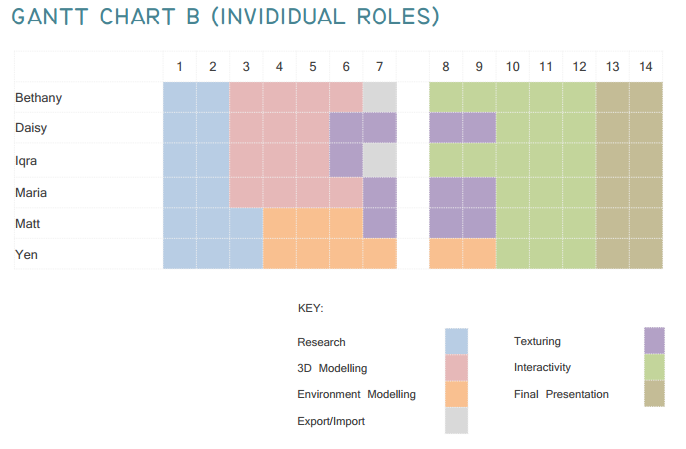
Through the use of planning they identified their aim and also created a useful Gantt chart, allowing them to keep on time with all the work needed to finalise their project. They have broken parts up into individual tasks allowing for complete group efficiency as well as creating set dates that things are due.


It is a really useful feature to have in a project and our group has already created a rough chart which will be expanded upon in light of the new information provided.

A negative aspect was their explanation on planning devices. It only outlines their communication methods rather than how it helps to plan. 
I also saw no evidence of the required 1000 word wiki, I don't know if these was meant to be presented today or later??

The final video was a great aspect of the presentation. It outlined individual tasks as well as providing information on how planning affected their project. It wasn't too content heavy and had many areas of comic relief allowing the audience to concentrate and enjoy a great end to a well planned out presentation.


Group: 
Bus Stop of The Future

Members: 
George Alagah, Violet Gan, Jason Lo, Michael Naumovski, Tony Tang

Presentation Analysis: 

The group used their own wiki as a form of presentation rather than a powerpoint which is what I gathered was part of the presentation so well done.

It did provide a problem as there were few images that helped to explain their view on planning and they were very generic, not helping at all. 

The group doesn't really outline what planning is, rather preferring to jump into how it affects their project. This doesn't affect them too much since the previous group did a good job on that part but it would have helped their presentation more if they had included a bit more.

Its clear during the presentation that there wasn't much planning in terms of the presentation with many of the group reading of the wiki or their phones instead of communicating with the class and presenting. 

Despite this it is clear that they have really expanded the planning topic over their project since it seems to have more of an effect due to the 20,000 budget they have. They have split into team roles as well as creating a Gantt chart that helps with project efficiency.

The video does expand more on planning in term so their group but it is very content heavy. It is obvious they are reading from sheets above the recorder and there is no change in the way they present, all of them sitting in a chair reading sentences about planning.
If you can get past this dull and heavy information the content is very good and does help the audience to understand their methods of planning.


Critical Reflection:

In terms of my own group, planning is a major part of our process to the end of our project.
It follows much in the same as the other Bus Stop Of The Future group that presented this week. We ourselves have created team member tasks as well as a gantt chart and how we will explore the spending of the 20,000 budget.


Project Manager : Overseeing all aspects of the project and ensuring the timetable is being fulfilledAnthony Chami

Documentation Group scribe that also floats around to all aspects of the project and finds alternative solutions. Our process of approval is that every member fulfil there task then gets check or helped by Martha then finalised by Anthony.Martha Masli

Precedents Research into Bus Stop regulations and dimensions in compliance with the City ofSydney and Ministry for Transport for New South Wales.Darren Weinman

Materials : Investigating numerous materials, searching for cost efficient building types as well as construction durability, supply and aesthetic appeal.Daniel Olivera Martha Masli

Connection methods : Research into various connection methods that can be used with the material(s) chosen as well as practicality. Assembly and disassembly factors will also be integrated.Kerre Skarparis / Daniel Olivera


These presentation along with my own experiences have outlined the uses of proper planning. It helps to keep your project on track as well as providing set times for certain tasks to be completed, meaning that you never loose sight of the final objective of completing your project.


Weekly Progress 5

A few members of both groups met up with Hank and Elliot on Tuesday to discuss various issues and progress on the project.

We originally though that the original files given to us were just prototypes and that we could change the design if needed. Upon making our own prototypes Hank told us that he wished to keep the design similar to the final design created during the Summer Elective Course. As a result it was back to the drawing board in terms of how the tension system would work in the original design.

This week both groups finally got certified to use the Laser Cutters in the Design Fabrication Labs in the Red Centre. It allowed us to finally start cutting prototype models and smaller scales and see if everything worked well with the intended connection methods.

In terms of materiality our group is quite set on using Plywood as our chosen material. We will go to Hank and determine with him as well as suppliers whether its better to use normal plywood without treatment, plywood with treatment or a marine grade plywood.

Each has its own positives and negatives such as pricing being more expensive as treatment for weather protection is added, and with a budget of 20,000 materials will be a major part of the costs so choosing wisely is a must.